Quick Answer: A Little Elly preschool franchise in India in 2026 reaches operational breakeven at around 35 admissions, typically within 12 to 18 months of opening. Full recovery of the initial investment then takes a further 2 to 3 years beyond that breakeven point, so a centre recovers its capital roughly 3 to 4.5 years after opening (Little Elly, 2026). The payback period is predictable because of how the model works: preschool revenue follows a fixed academic calendar, fees are tied to enrolment, and a child who joins in playgroup often continues through nursery, LKG, and UKG. The investment being recovered is ₹14 lakh to ₹20 lakh for a Little Elly franchise, alongside an ongoing royalty of 14% on every fee a parent pays (Little Elly, 2026). The sector backdrop is favourable: India’s pre-school and childcare market reached USD 5.1 billion in 2025 and is projected to reach USD 12.0 billion by 2034 (IMARC Group, 2026).
TL;DR
- Operational breakeven: A Little Elly centre typically reaches operational breakeven at around 35 admissions, within 12 to 18 months of opening (Little Elly, 2026).
- Full payback: Recovery of the full ₹14 lakh to ₹20 lakh investment takes a further 2 to 3 years beyond operational breakeven, roughly 3 to 4.5 years from opening (Little Elly, 2026).
- Worked example: On an indicative ₹60,000 annual fee per child, a franchisee pays the brand about ₹12,900 (₹8,400 royalty plus roughly ₹4,500 kit charges) and retains roughly ₹47,100 per child before running costs (Little Elly, 2026).
- The main lever: Enrolment count is the single biggest driver of payback speed, because fixed costs such as rent and core salaries do not change with the number of children enrolled.
- Recurring drag: Little Elly’s royalty is 14% on every fee a parent pays, plus annual per-child kit charges of roughly ₹4,000 to ₹5,000 (Little Elly, 2026).
What the Payback Period Actually Means
The payback period is the time it takes for the cumulative surplus from a preschool franchise to recover the original investment. It is not the same as operational breakeven, and confusing the two leads to weak financial planning.
There are two distinct milestones in a preschool franchise’s financial life. Operational breakeven is the point where monthly fee collection covers monthly running costs such as rent, salaries, and utilities. Full capital payback is the later point where the accumulated monthly surplus has fully recovered the investment put in at the start.
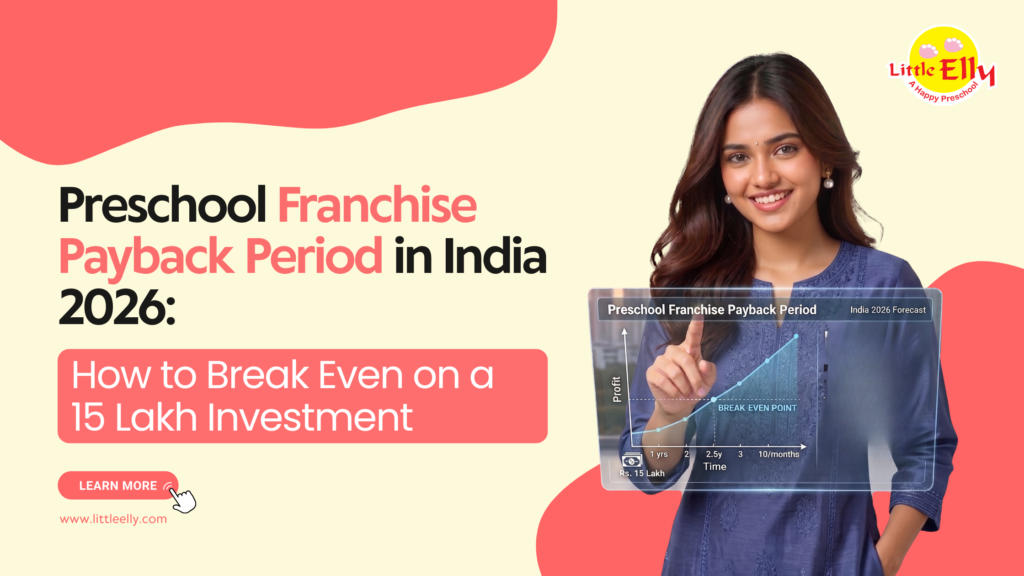
For a Little Elly franchise, operational breakeven typically arrives at around 35 admissions, within 12 to 18 months of opening (Little Elly, 2026). Full recovery of the ₹14 lakh to ₹20 lakh investment then takes a further 2 to 3 years beyond that point, as second-year and third-year surpluses accumulate, putting full capital payback at roughly 3 to 4.5 years from opening.
The 35-Admission Breakeven Threshold
For a Little Elly franchise, the operational breakeven point is reached at around 35 admissions (Little Elly, 2026). This single number is the most useful benchmark a prospective franchisee can plan against.
The reason a fixed admission count works as a threshold is that a preschool’s costs are mostly fixed. Rent does not change with enrolment. Core teaching and support salaries are set by the brand’s age-group ratios rather than by how many seats are filled. So once fee income from roughly 35 enrolled children covers those fixed monthly costs, the centre has crossed operational breakeven, and each admission beyond that point contributes to surplus.
This is why enrolment pace, not fee level alone, is the dominant lever on payback speed. A centre that fills its first 35 seats quickly crosses breakeven sooner and begins building the surplus that recovers capital.
A Worked Example: Where the Money Goes Per Child
The payback mechanism becomes concrete once the per-child economics are laid out. The figures below are indicative sample numbers shared by the Little Elly franchise team, not fixed rates, and actual fees vary by centre and city (Little Elly, 2026).
Take an indicative annual fee of ₹60,000 paid by a parent for one child. On that fee, the franchisee pays the brand a 14% royalty, which is ₹8,400, plus annual kit charges of roughly ₹4,500. That is about ₹12,900 per child going to the brand. The franchisee retains the balance, roughly ₹47,100 per child (Little Elly, 2026).
| Per child, indicative | Amount (INR) |
| Annual fee paid by parent | 60,000 |
| Royalty to brand (14% of fee) | 8,400 |
| Kit charges (annual) | 4,500 |
| Total to brand | 12,900 |
| Retained by franchisee | 47,100 |
One point matters more than any other here. The ₹47,100 retained per child is not profit. It is the amount left with the centre before rent, staff salaries, utilities, and other running costs are paid. Those operating costs are met out of the pooled retained amount across all enrolled children. Profit is whatever remains after every centre with that enrolment has paid those costs, and it varies too widely to state as a single figure.
At the centre level, Little Elly indicates that a single centre can generate up to roughly ₹40 to ₹50 lakh in gross revenue at around 100 admissions (Little Elly, 2026). Revenue is seasonal and tied to the academic calendar, so there is no fixed monthly figure. This gross revenue is the total fees collected, a different measure from the franchisee-retained amount, and the two should never be confused when planning.
The Variables That Decide Your Payback Period
Beyond the 35-admission threshold, the payback timeline on a preschool franchise is governed by a small set of variables. Every payback outcome reduces to how well a franchisee manages these.
Enrolment pace is the largest lever. The faster a centre fills seats toward and beyond the 35-admission breakeven point, the faster it crosses into surplus, because fixed costs such as rent and core salaries do not move with enrolment.
Fee level is the second variable. A higher annual fee per child increases the amount retained per admission and shortens payback, but only if enrolment holds at that price point. Setting a fee too low to compete makes each admission less valuable and lengthens recovery.
Fixed monthly cost is the third. Rent and payroll are the dominant recurring costs, and a Little Elly franchise budgets an ideal monthly rent of roughly ₹75,000 to ₹1,00,000 (Little Elly, 2026). Lower fixed costs mean fewer admissions are needed to break even, and a leaner cost base pulls the payback period toward the shorter end of the range.
A franchisee who manages all three, fills seats quickly, sets a sustainable fee, and keeps fixed costs lean, compresses the payback period toward the 12-month end of the operational-breakeven window.
Why Preschool Payback Is More Predictable Than Other Franchises
The preschool model has financial characteristics that make its payback period unusually reliable compared with other franchise categories.
Revenue is recurring and calendar-driven. Preschools collect fees on a fixed academic cycle, and admissions typically begin one to two months before the academic year, which lets a centre forecast its intake before the year starts. With Little Elly, the franchise sales cycle itself runs roughly one to two months from first contact to signing (Little Elly, 2026).
Retention compounds the revenue. A child who joins in playgroup often stays through nursery, LKG, and UKG, so each academic year retains a base of students and adds a new intake on top. Little Elly’s curriculum is structured across these four levels, from playgroup at ages 2 to 3 through UKG at ages 5 to 6 (Little Elly, 2026).
Demand is also structurally rising. The National Education Policy 2020 restructured school education into a 5+3+3+4 design and created a Foundational Stage covering ages 3 to 8, formally recognising preschool within the schooling system (PRS India, 2020). India’s pre-school and childcare market reached USD 5.1 billion in 2025 and is projected to reach USD 12.0 billion by 2034, a 9.16% compound annual growth rate (IMARC Group, 2026).
How to Shorten Your Payback Period
Three practical levers compress the payback period on a preschool franchise investment.
The first is starting the admissions campaign early. Because admissions open one to two months before the academic year, a centre that markets ahead of that window fills more seats in its first intake and reaches the 35-admission breakeven point sooner. Little Elly supplies branding materials, digital marketing assets, and support for local advertising to help partners promote within their community (Little Elly, 2026).
The second is keeping fixed costs lean at launch. Rent and payroll are the dominant recurring costs, and payroll scales with enrolment. Matching staff to the brand’s age-group ratios, rather than over-hiring before seats fill, protects early cash flow. Little Elly’s playgroup ratio is one teacher plus one support staff for every 10 to 12 children (Little Elly, 2026).
The third is choosing a brand with strong operational support. Faster enrolment and fewer early mistakes shorten payback. Little Elly provides continuous post-launch support covering operations, curriculum updates, and marketing, backed by a 22-year track record and a network of 172-plus franchisees across 19 cities (Little Elly, 2026).
What Can Extend the Payback Period
The payback period stretches toward the longer end of the range, or beyond, when specific risks are not managed.
Slow enrolment is the primary risk. Fixed costs such as rent and core salaries continue regardless of how many seats are filled, so a centre that takes longer to reach 35 admissions carries those costs longer before crossing breakeven.
Two other factors matter. Setting fees too low to compete makes each admission less valuable and lengthens recovery. Over-hiring before enrolment justifies it inflates payroll, the largest recurring cost, before revenue can support it.
A franchisee should also plan a working-capital cushion. A Little Elly franchise budgets two months of working capital within its capital expenditure, but a cautious owner holds additional reserves so that a slow first intake does not threaten the centre before it stabilises across the first academic year.
Frequently Asked Questions
What is the payback period for a preschool franchise in India in 2026? A Little Elly franchise typically reaches operational breakeven at around 35 admissions, within 12 to 18 months of opening. Full recovery of the ₹14 lakh to ₹20 lakh investment then takes a further 2 to 3 years beyond breakeven, so a centre recovers its capital roughly 3 to 4.5 years after opening (Little Elly, 2026).
What is the difference between operational breakeven and full payback? Operational breakeven is when monthly fee collection covers monthly running costs such as rent and salaries. Full payback is the later point where cumulative surplus has recovered the entire ₹14 lakh to ₹20 lakh investment (Little Elly, 2026).
How much does a franchisee keep from each child’s fee? On an indicative ₹60,000 annual fee, a franchisee pays the brand about ₹12,900, which is ₹8,400 royalty plus roughly ₹4,500 kit charges, and retains around ₹47,100 per child (Little Elly, 2026). That retained amount is before rent, salaries, and other running costs, so it is not profit. These are indicative sample figures and vary by centre.
How many admissions does a preschool need to break even? A Little Elly centre typically reaches operational breakeven at around 35 admissions (Little Elly, 2026). Because rent and core salaries are fixed, fee income from roughly that many children covers the centre’s monthly running costs.
What recurring costs affect the payback period? Little Elly charges a 14% royalty on every fee a parent pays, plus annual per-child kit charges of roughly ₹4,000 to ₹5,000 (Little Elly, 2026). Operating costs of rent, staff salaries, and utilities run separately, with an ideal monthly rent of roughly ₹75,000 to ₹1,00,000.
Why is preschool payback more predictable than other businesses? Preschool revenue follows a fixed academic calendar, admissions open one to two months before the year starts, and retention compounds as children continue from playgroup through UKG (Little Elly, 2026). Each academic year retains a base of students and adds a fresh intake.
What slows down the payback period? Slow enrolment is the main risk, since fixed costs continue regardless of seat count. Setting fees too low and over-hiring before enrolment justifies it also extend recovery. Holding working-capital reserves beyond the two months built into the investment cushions a slow first intake.
Sources
- Little Elly, “Franchise Programme”, 2026 (Little Elly is a preschool brand operated by Learning Edge India, its holding company. Fee, royalty-split and revenue figures in this article are indicative sample numbers supplied by the Little Elly franchise team, May 2026.)
- IMARC Group, “Indian Pre-School/Childcare Market Size, Share, Trends and Forecast 2026-2034”
- PRS India, “National Education Policy 2020”, Committee Report Summary