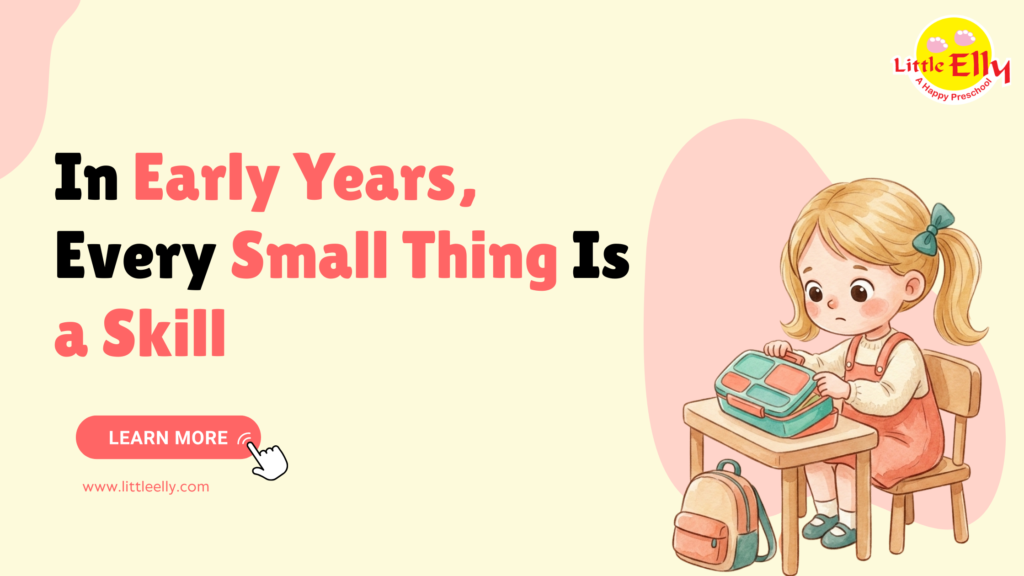
In Early Years, Every Small Thing Is a Skill
Most people don’t immediately recognise what’s going on inside an Early Years classroom.
If you walk in and take a quick look, it can seem like a lot of things are happening at once. Children are moving between activities, some are talking, some are distracted, a few are deeply focused, and others are halfway through something they’ve already abandoned. It doesn’t always match the neat, structured idea of what learning is supposed to look like.
But that impression changes when you stop looking for structure and start paying attention to the details.
A child sitting with a lunchbox, trying to get it open, might not seem like much. But watch closely and you’ll see the effort behind it. They adjust their grip, try a different angle, pause when it doesn’t work, and then go again. No one announces this as a learning moment, but it is one.
The same thing happens with everyday routines. Wearing shoes, for example, is rarely straightforward in the beginning. Shoes go on the wrong feet. They feel uncomfortable. The child notices, takes them off, and tries again. It’s a slow process, but it’s doing its job.
Even moments that look quiet or passive are not really passive. Sitting with a group, listening to someone else, or waiting for a turn takes more effort than we tend to realise. For a young child, these are not habits yet. They are still being learned.
This is also why you’ll see the same things happening again and again.
It’s not repetition in the way adults think of it. It’s more like practice without pressure. Children return to what they’ve done before because they’re still figuring it out. Each attempt is slightly different from the last, even if it looks the same from the outside.
And progress doesn’t always show up clearly.
A child who struggled to share yesterday might still struggle today, but maybe there’s a moment where they hesitate before reacting. Maybe they look at the adult instead of immediately grabbing the toy. It’s a small change, but it counts.
The classroom is set up in a way that allows these moments to happen naturally. Children are given space to try things on their own, to get them wrong, and to come back to them without feeling rushed.
Over time, they start picking things up.
They wait a little longer than before.
They try again without being told to.
They ask for help instead of giving up completely.
None of this looks dramatic, but it adds up.
When people talk about learning, they usually focus on things that are easy to measure, like reading or writing. But those things don’t develop in isolation. They sit on top of skills that are built much earlier, in ways that are less obvious.
A child building something with blocks is learning how to stay with a task.
A child putting things away is learning responsibility, even if they don’t think of it that way.
A child saying “I can’t do this” and then trying again is already moving forward.
This is what Early Years really looks like.
It’s not loud in the way people expect learning to be. It doesn’t always stand out. But it’s there, in the middle of ordinary moments that repeat every day.
And slowly, something shifts.
Children begin to do things they once avoided. They rely a little less on constant help. They start making small decisions with more confidence than before.
At some point, without it being made into a big deal, they begin to trust themselves a bit more.
That’s the part that matters.
Because in Early Years, nothing is just a small thing.
Admissions open for 2026-2027