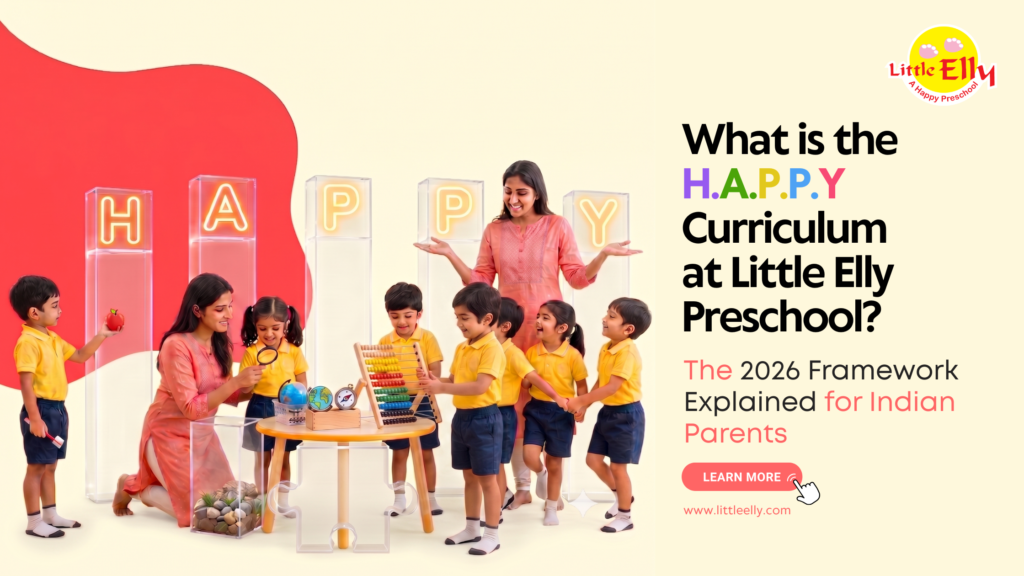
Quick Answer: The H.A.P.P.Y curriculum is Little Elly Preschool’s early childhood education framework, built on the principle that a child’s intelligence is shaped by the connections formed between brain cells, cultivated through early experiences and stimuli, rather than the number of cells a child is born with (Little Elly, 2026). H.A.P.P.Y is an acronym for the five pillars the curriculum is built on: Health, Acute Senses, Practical Life Skills, Purposeful Fun, and the YAY! Approach (Little Elly, 2026). It is not a single teaching method but a handpicked blend of renowned educational methodologies, drawing on the Montessori, Waldorf, Gardner, and Bloom approaches alongside Learning Style Theory (Little Elly, 2026). The curriculum is delivered through six areas of learning and development across Little Elly’s toddler, nursery, and kindergarten programs. For Indian parents, the practical takeaway is that the H.A.P.P.Y curriculum aims to develop the whole child rather than focus narrowly on academic readiness.
TL;DR
- What it is: The H.A.P.P.Y curriculum is Little Elly’s early years framework, built on the idea that intelligence grows from brain-cell connections formed through early experiences (Little Elly, 2026).
- The acronym: H.A.P.P.Y stands for Health, Acute Senses, Practical Life Skills, Purposeful Fun, and the YAY! Approach (Little Elly, 2026).
- The methodology: It blends four established approaches, Montessori, Waldorf, Gardner, and Bloom, with Learning Style Theory, rather than following one single method (Little Elly, 2026).
- Six learning areas: Delivery is structured across communication, language and literacy; physical development; social and emotional development; mathematics development; understanding the world; and expressive arts (Little Elly, 2026).
- Why it matters: The curriculum is designed for holistic development, building independence, curiosity, and confidence in a child’s early years (Little Elly, 2026).
The Idea Behind the H.A.P.P.Y Curriculum
The H.A.P.P.Y curriculum starts from a specific idea about how children develop. A child’s inherent intelligence is not determined by the number of brain cells they are born with, but by the connections formed between those cells, and these connections are cultivated through the experiences and stimuli provided in the early years (Little Elly, 2026).
This principle shapes the whole design. The curriculum aims to nurture those connections by creating a diverse and engaging environment that stimulates various aspects of a child’s brain (Little Elly, 2026).
For Indian parents, this explains why the curriculum is activity-rich rather than worksheet-heavy. Caregivers and educators provide a multifaceted environment that encourages exploration, critical thinking, and curiosity, laying the groundwork for holistic development (Little Elly, 2026).
What Each Letter in H.A.P.P.Y Stands For
H.A.P.P.Y is an acronym, and each letter represents one pillar of the curriculum (Little Elly, 2026).
Health is the first pillar. Its primary focus is to stimulate the child’s mental development, with significant emphasis on proper nutrition, delivered through regularly updated booklets and other resources.
Acute Senses is the second. Because a child learns through their five senses, building strong senses is treated as vital for successful learning. This pillar covers eye-tracking skills, early musical skills, listening skills, and physical motor skills such as finger and thumb control.
Practical Life Skills is the third. Teaching practical life skills is treated as crucial for holistic development and the cultivation of independence, equipping children with essential abilities for daily living.
Purposeful Fun is the fourth. The curriculum is centred on engaging games and activities, each designed with a specific purpose, so that activities are enjoyable but also foster physical, emotional, or intellectual development.
The YAY! Approach is the fifth. This pillar embraces the natural enthusiasm of young learners, aiming to ignite and nurture curiosity by creating a vibrant atmosphere of enthusiasm that fuels learning.
Why the H.A.P.P.Y Curriculum Blends Several Teaching Methods
A defining feature of the H.A.P.P.Y curriculum is that it is not built on one teaching philosophy. Little Elly adopts a combination of philosophies to tailor the educational experience to each child’s individual needs (Little Elly, 2026).
The Montessori approach contributes self-directed learning, independence, and hands-on exploration. Each Little Elly centre has a dedicated motor skills room, a prepared environment where children work with practical and sensory materials to promote hands-on discovery (Little Elly, 2026).
The Waldorf approach contributes holistic development. A theme is chosen each month, and that theme dictates the month’s activities, with natural materials and imaginative play running throughout (Little Elly, 2026).
The Gardner approach applies Howard Gardner’s theory of multiple intelligences, which holds that intelligence is a collection of distinct types rather than a single trait, commonly described as around eight intelligences (Little Elly, 2026). Little Elly uses this idea to design activities that reach different kinds of intelligence rather than assuming every child learns the same way.
The Bloom approach uses Bloom’s Taxonomy, a set of three domains, cognitive, affective, and psychomotor, to ensure children engage with different levels of thinking, not just memorisation (Little Elly, 2026).
The curriculum also applies Learning Style Theory, which recognises that individuals have distinct preferred ways of absorbing and processing information, so teachers can identify how each child best learns (Little Elly, 2026).
The Six Areas of Learning and Development
The H.A.P.P.Y curriculum is delivered through six structured areas of learning and development. Together they ensure the curriculum addresses every dimension of a child’s growth (Little Elly, 2026).
The six areas are communication, language and literacy; physical development; social and emotional development; mathematics development; understanding the world; and expressive arts (Little Elly, 2026).
For an Indian parent, this structure answers a common question: whether a play-based preschool still builds academic foundations. The mathematics development and the communication, language and literacy areas address school-readiness skills, while physical, social, and emotional development cover the wider growth that early years education is meant to support.
What the H.A.P.P.Y Curriculum Means for Your Child
For parents choosing a preschool, the H.A.P.P.Y curriculum translates into a specific kind of classroom experience.
The first outcome is individualised learning. Little Elly teachers observe each child’s interests, strengths, and needs to tailor instruction, and children are given the freedom to express and pursue their interests in a supportive environment (Little Elly, 2026). This reflects the Montessori principle that each child is respected and valued.
The second outcome is a focus on independence and confidence. The curriculum is designed to build skills such as communication, creativity, and confidence as children move through the preschool years toward formal school (Little Elly, 2026).
The third outcome is consistency at scale. The H.A.P.P.Y curriculum is delivered across Little Elly’s network of more than 170 centres, backed by a 22-year operating history and more than 2.5 lakh children nurtured (Little Elly, 2026). A parent enrolling a child is choosing a structured, established framework rather than an ad hoc programme.
Frequently Asked Questions
What does H.A.P.P.Y stand for in the Little Elly curriculum? H.A.P.P.Y is an acronym for the five pillars of Little Elly’s curriculum: Health, Acute Senses, Practical Life Skills, Purposeful Fun, and the YAY! Approach (Little Elly, 2026). Each pillar targets a different dimension of early childhood development.
Is the H.A.P.P.Y curriculum based on Montessori? The H.A.P.P.Y curriculum uses the Montessori approach but is not solely Montessori. It blends Montessori with the Waldorf, Gardner, and Bloom approaches and Learning Style Theory (Little Elly, 2026). The Montessori element contributes self-directed learning and hands-on exploration.
Does the H.A.P.P.Y curriculum prepare children for school? Yes. The curriculum includes mathematics development and communication, language and literacy among its six areas of learning (Little Elly, 2026). These build school-readiness skills alongside the wider social and emotional development that early years education supports.
What are the six areas of learning in the H.A.P.P.Y curriculum? The six areas are communication, language and literacy; physical development; social and emotional development; mathematics development; understanding the world; and expressive arts (Little Elly, 2026). Together they address the whole child rather than academics alone.
How is the H.A.P.P.Y curriculum tailored to each child? Little Elly teachers observe each child’s interests, strengths, and needs to tailor instruction accordingly (Little Elly, 2026). The curriculum also applies Learning Style Theory to identify how each child best absorbs and processes information.
What age group is the H.A.P.P.Y curriculum for? The curriculum is delivered across Little Elly’s toddler, nursery, and kindergarten programs, covering children from roughly age 2 to 6 (Little Elly, 2026).
Sources
- Little Elly, “H.A.P.P.Y Curriculum: Nurturing Minds”, 2026
- Little Elly, “Best Preschool, Playschool & Kindergarten”, 2026 (Little Elly is a preschool brand operated by Learning Edge India)