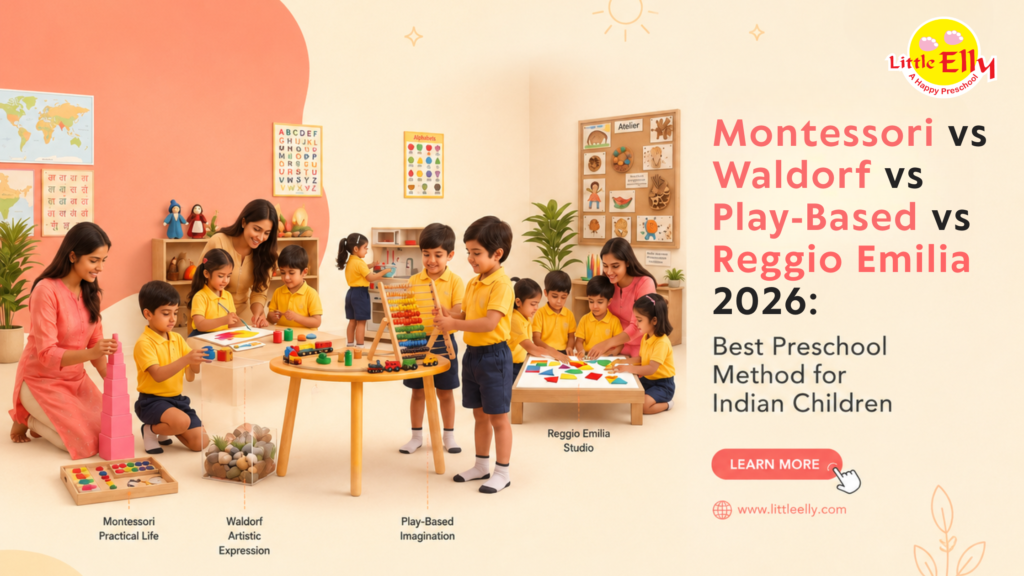
Quick answer: There is no single best preschool method for Indian children in 2026. Montessori, Waldorf, play-based and Reggio Emilia are four respected early-learning philosophies, and the right one depends on your child’s temperament, not on which is “superior.” All four share a child-centred core, and all four align broadly with what India’s National Education Policy 2020 asks for: flexible, play-based and activity-based learning rather than early academic pressure (Press Information Bureau, 2020). Many strong Indian preschools deliberately blend elements of more than one.
TL;DR
- Montessori centres on self-directed learning in a carefully “prepared environment” of hands-on materials (Simply Psychology, 2024).
- Waldorf (Steiner) builds early years around imaginative play, rhythm and storytelling, and introduces formal academics later, around age 7 (Early Excellence, 2026).
- Play-based learning makes play the main vehicle of learning, and is the approach NEP 2020 endorses for India’s Foundational Stage (Press Information Bureau, 2020).
- Reggio Emilia uses an emergent, child-led curriculum and treats the classroom environment as a “third teacher” (EBSCO Research Starters, 2026).
- No method is proven universally best; the right fit depends on the child, and blended curricula are common in India (Little Elly, 2026).
Why Preschool Method Matters in India in 2026
Choosing a preschool method is one of the first real decisions parents make about how their child will learn. It matters more in 2026 because India now has a national benchmark for the early years. The National Education Policy 2020 created a single Foundational Stage covering ages 3 to 8 and states that Early Childhood Care and Education should be flexible, multi-level, play-based and activity-based, not academically pressured (Press Information Bureau, 2020).
India’s National Curriculum Framework for the Foundational Stage, released by NCERT in 2022, reinforces this by placing play at the centre of early learning (Press Information Bureau, 2022). The useful takeaway for parents: all four methods below are child-centred and broadly aligned with this national direction. The choice is about fit, not about which one is “allowed.”
Montessori: Independence in a Prepared Environment
The Montessori method was developed by Dr Maria Montessori, who opened her first Casa dei Bambini, or Children’s House, in 1907. It is a child-centred approach built on self-directed learning, hands-on materials and respect for each child’s pace (Simply Psychology, 2024).
Its defining feature is the “prepared environment”: a carefully ordered classroom where every material has a purpose and a place, and children are free to choose their work and learn through hands-on experience (Montessori Academy, 2025). Montessori suits a child who thrives on order, independence and quiet, focused work, and parents who value self-reliance.
Waldorf: Imagination, Rhythm and Unhurried Learning
Waldorf education, also called Steiner education, was founded by Rudolf Steiner, with the first Waldorf school opening in 1919 in Stuttgart, Germany (London School of Childcare Studies, 2025).
In the early years, Waldorf prioritises imaginative play, imitation, storytelling, art and a strong daily, weekly and seasonal rhythm, and it deliberately delays formal reading and writing until around age 7 (Early Excellence, 2026). It is worth noting that evidence on delayed academics is mixed, so this is a philosophy choice rather than a settled scientific advantage. Waldorf suits a child who flourishes with creativity, routine and an unhurried start, and parents comfortable with academics arriving later.
Play-Based Learning: The Approach NEP 2020 Endorses
Play-based learning makes play itself the primary vehicle for learning, with children building language, motor, social and thinking skills through activity rather than instruction.
This is the approach India’s own policy framework endorses. NEP 2020 defines the Foundational Stage as play-based and activity-based (Press Information Bureau, 2020), and the National Curriculum Framework for the Foundational Stage places play at the centre of early learning (Press Information Bureau, 2022). Play-based learning suits almost every young child and reassures parents who want a method clearly in step with India’s national curriculum direction.
Reggio Emilia: Child-Led Discovery and the “Third Teacher”
The Reggio Emilia approach was developed in post-World War II Italy under educator Loris Malaguzzi. It views the child as a competent, capable learner and active participant in their own education (EBSCO Research Starters, 2026).
Reggio uses an emergent curriculum that grows from children’s interests rather than a fixed plan, treats the classroom environment as a “third teacher” alongside parents and educators, and encourages children to express ideas through many forms, often called the “hundred languages of children” (Early Excellence, 2026). Reggio suits a curious, expressive child and parents who value creativity, exploration and project-led discovery.
Montessori vs Waldorf vs Play-Based vs Reggio Emilia: A Comparison
The table summarises how the four methods differ on the points parents most often weigh.
| Method | Core idea | Role of the teacher | Best fit for |
| Montessori | Self-directed work in a prepared environment (Simply Psychology, 2024) | Guide who prepares the environment and observes | A child who likes order and independent, focused work |
| Waldorf | Imagination, rhythm, delayed formal academics (Early Excellence, 2026) | Role model leading rhythmic, artistic routines | A child who thrives on creativity and an unhurried start |
| Play-Based | Play as the primary vehicle of learning (Press Information Bureau, 2020) | Facilitator who plans and extends play | Almost any young child; aligns with NEP 2020 |
| Reggio Emilia | Emergent, child-led curriculum; environment as “third teacher” (EBSCO, 2026) | Co-learner who follows children’s interests | A curious, expressive, project-loving child |
No row in this table is the “winning” row. Each method is strong for the child it fits.
So Which Is Best for Indian Children?
The honest answer is that no single method is proven universally best, and the four overlap more than they differ. All are child-centred, all favour learning through experience over rote memorisation, and all align with the play-based direction of NEP 2020 and the National Curriculum Framework (Press Information Bureau, 2020).
This is why many of India’s established preschools do not adopt one pure method but blend them. Little Elly’s H.A.P.P.Y Curriculum is a clear example: it combines Montessori-inspired independence, Steiner-inspired imagination and rhythm, and play-based experiential learning into one progression from sensory exploration toward school readiness (Little Elly, 2026). For most Indian families, a thoughtfully blended, play-based programme delivered by trained teachers will serve a child better than a rigid commitment to a single label. Choose for your child’s temperament, and judge the preschool on its teachers and environment, not its method name.
Frequently Asked Questions
What is the best preschool method for a child in India? There is no single best method. Montessori, Waldorf, play-based and Reggio Emilia are all child-centred and all align with the play-based learning NEP 2020 endorses for India’s Foundational Stage (Press Information Bureau, 2020). The right choice depends on your child’s temperament and the quality of the specific preschool.
What is the main difference between Montessori and Waldorf? Montessori centres on self-directed work with structured, hands-on materials in a prepared environment (Simply Psychology, 2024). Waldorf centres on imaginative play, rhythm and storytelling and delays formal academics until around age 7 (Early Excellence, 2026). Montessori is more structured; Waldorf is more imagination-led.
How is Reggio Emilia different from play-based learning? Both are child-centred, but Reggio Emilia uses a specific emergent curriculum that grows from children’s interests and treats the environment as a “third teacher” (EBSCO Research Starters, 2026). Play-based learning is the broader principle of learning through play, and is the approach NEP 2020 endorses for India.
Does NEP 2020 recommend a particular preschool method? NEP 2020 does not endorse one named method. It states that Early Childhood Care and Education for the Foundational Stage should be flexible, play-based and activity-based rather than academically pressured (Press Information Bureau, 2020). All four methods in this guide broadly fit that direction.
Can a preschool use more than one method? Yes, and many do. Blended curricula are common in India. Little Elly’s H.A.P.P.Y Curriculum, for example, combines Montessori-inspired independence, Steiner-inspired imagination and play-based learning into one programme (Little Elly, 2026). A well-designed blend can suit a wider range of children than a single pure method.
Sources
- Press Information Bureau, Government of India, “Cabinet Approves National Education Policy 2020” (29 July 2020): https://www.pib.gov.in/PressReleasePage.aspx?PRID=1642049
- Press Information Bureau, Ministry of Education, “National Curriculum Framework for Foundational Stage and pilot project of Balvatika 49 Kendriya Vidyalayas launched” (19 December 2022): https://www.pib.gov.in/PressReleaseIframePage.aspx?PRID=1884943
- Simply Psychology, “Maria Montessori Theory of Education”: https://www.simplypsychology.org/montessori-method-of-education.html
- Montessori Academy, “Principles of Montessori Education”: https://montessoriacademy.com.au/montessori-education/principles-of-montessori-education/
- London School of Childcare Studies, “The Waldorf-Steiner Approach”: https://childcarestudies.co.uk/blog/the-waldorf-steiner-approach/
- Early Excellence, “Steiner Education, Steiner Schools”: https://earlyexcellence.com/practice-and-pedagogy/steiner-education-steiner-schools/
- Early Excellence, “The Reggio Emilia Approach”: https://earlyexcellence.com/practice-and-pedagogy/reggio-emilia-approach/
- EBSCO Research Starters, “Reggio Emilia Approach”: https://www.ebsco.com/research-starters/education/reggio-emilia-approach
- Little Elly, official website: https://www.littleelly.com/