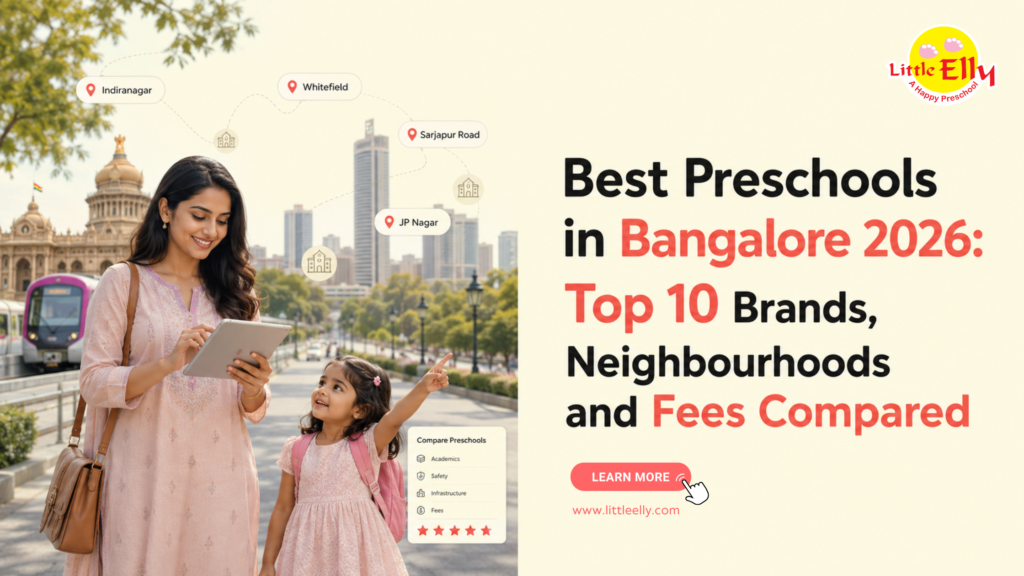
Quick Answer: The best preschool in Bangalore in 2026 is not a single brand, it is the centre that matches your child’s age, your home’s commute, and your family’s view of what early learning should be. Bangalore parents choosing a preschool this year are weighing three things: curriculum philosophy, classroom safety and ratios, and annual fees that commonly run between INR 27,000 and INR 72,000 depending on locality and format (RentoMojo, 2024). India’s National Education Policy 2020 places the foundational years at ages 3 to 8 and notes that over 85% of a child’s cumulative brain development occurs before age 6, which is why this decision carries more weight than its price tag suggests (National Education Policy 2020, Government of India). The right preschool depends on how your child learns, not just which brand markets hardest.
TL;DR
- Market: India’s pre-school and childcare market was valued at an estimated USD 5.1 billion in 2025, and Bengaluru is one of six major city markets tracked nationally (IMARC Group, 2026).
- Curriculum: NEP 2020 frames ages 3 to 8 as one Foundational Stage built on play, activity and inquiry, not rote learning (NEP 2020).
- Fees: Annual preschool fees in Bangalore commonly range from around INR 27,000 to INR 72,000, with premium and international formats charging more (RentoMojo, 2024).
- Demand: Karnataka is among the strongest states in the country for early-years enrollment, with pre-primary enrollment for 4-year-olds above 95% (ASER 2024, Press Information Bureau).
- Quality: Trained teachers, low ratios, and a named curriculum framework separate a strong preschool from an average one, in a sector where educator shortages make quality uneven (IMARC Group, 2026).
The State of Bangalore’s Preschool Market in 2026
Bangalore’s preschool market sits inside a national sector growing fast. The Indian pre-school and childcare market was valued at an estimated USD 5.1 billion in 2025 and is projected to reach USD 12.0 billion by 2034, growing at 9.16% a year (IMARC Group, 2026). Bengaluru is one of six major city markets IMARC tracks for this sector, alongside Delhi-NCR, Hyderabad, Chennai, Mumbai and Kolkata.
What this means on the ground is choice, and choice that is hard to compare. Private operators hold 89.2% of India’s preschool market, and standalone neighbourhood centres account for 48.5% of all locations (IMARC Group, 2026). In a city like Bangalore that translates into hundreds of preschools across every micro-market, from chain brands to single-centre operators, with no single regulator setting a common standard.
Demand is genuine, not manufactured. Karnataka is among the leading states in India for early-years enrollment, with pre-primary enrollment for 4-year-olds exceeding 95% and enrollment for 5-year-olds above 90%, according to the Annual Status of Education Report (ASER) 2024 (Press Information Bureau, 2025). Bangalore parents are not deciding whether to send a child to preschool. They are deciding which one.
Why the Early Years Carry So Much Weight
A preschool decision is really a decision about a child’s first structured environment. India’s National Education Policy 2020 reorganised school education into a 5+3+3+4 structure and created a single Foundational Stage covering ages 3 to 8, made up of three years of preschool and the first two years of primary school (National Education Policy 2020, Government of India).
The policy is explicit about why this stage matters. It states that over 85% of a child’s cumulative brain development occurs before the age of 6 (NEP 2020). The years a child spends in a Bangalore preschool fall almost entirely inside that window.
NEP 2020 also defines what good early learning looks like: flexible, multi-level, play-based and activity-based learning, rather than early academic pressure (NEP 2020). This is the single most useful benchmark a parent has. A preschool that pushes formal reading and writing too early is working against the national framework, not ahead of it.
How to Read a Preschool’s Curriculum
Most preschool websites describe their curriculum in similar warm language. The way to cut through it is to ask how the curriculum is structured across age groups, because real early-years programmes progress in clear stages.
Little Elly, the Learning Edge India preschool brand operating across Bangalore, structures its programme into four stages: Playgroup for ages 2 to 3, Nursery for 3 to 4, LKG for 4 to 5, and UKG for 5 to 6 (Little Elly, 2026). The progression moves a child from settling and sensory exploration in Playgroup, through vocabulary and pre-writing readiness in Nursery, into phonics and number concepts in LKG and UKG. That staged design is what NEP 2020’s play-based foundational model asks for.
The curriculum framework should also have a name and a defined philosophy. Little Elly’s curriculum is called the H.A.P.P.Y Curriculum, built on five pillars: Health, Acute Senses, Purposeful Fun, Practical Life, and the Yay! Approach (Little Elly, 2025). A named, documented framework is easier to evaluate than a vague promise of “holistic development”, because you can ask exactly how each pillar shows up in a child’s day.
When you visit a preschool, ask three questions: how the curriculum changes between age groups, what learning philosophy shapes it, and how the centre tracks a child’s progress without pressure-based testing. Strong preschools answer all three specifically.
What Preschool Fees in Bangalore Actually Look Like
Fees are where comparison gets hardest, because Bangalore preschools price very differently. Annual preschool fees in the city commonly range from around INR 27,000 to INR 72,000, varying by curriculum, brand and locality, with premium and international formats charging above that band (RentoMojo, 2024).
A higher fee is not automatically a better preschool. The cost reflects locality real estate, infrastructure, staff ratios and brand positioning as much as teaching quality. Two preschools on the same road can differ in fees by a wide margin and offer broadly similar early-years outcomes.
What a fee should buy is specific and checkable. Ask what the fee covers beyond tuition, such as activity kits, teaching aids, meals or transport, and ask for the figure in writing for the full academic year. A clear, itemised fee is itself a signal of an organised, transparent preschool.
Choosing the Right Bangalore Neighbourhood
Neighbourhood matters more than parents expect, because a preschooler’s day is short and a long commute eats into it. The best preschool in Whitefield is rarely the best choice for a family in Jayanagar, regardless of reputation.
The practical rule is proximity first. A preschool within 15 to 20 minutes of home reduces a young child’s travel fatigue, makes pickup during minor illness manageable, and lets parents attend the parent-teacher meetings and observation sessions that good preschools run regularly. Bangalore’s spread, from Whitefield and Sarjapur in the east to Hebbal in the north and Jayanagar and JP Nagar in the south, means most families have several credible options within their own micro-market.
Because standalone neighbourhood centres make up 48.5% of India’s preschool locations (IMARC Group, 2026), a strong local option usually exists close to home. Shortlist by locality first, then compare curriculum, safety and fees within that shortlist.
What Separates a Strong Preschool from an Average One
In a sector where India faces a shortage of formally trained early childhood educators and fragmented, state-level regulation, quality between preschools is genuinely uneven (IMARC Group, 2026). A few signals reliably separate a serious preschool from an average one.
- Teacher-to-child ratios that are stated and low. Young children need individual attention. Little Elly’s general classroom structure places one teacher and one support staff for every 10 to 12 children at Playgroup level, scaling up through the older groups (Learning Edge India, 2026). A preschool that cannot tell you its ratios is a preschool to question.
- Safety systems that are designed, not improvised. This means CCTV monitoring in key areas, supervised arrival and dispersal, authorized-pickup systems, and verification of every staff member before joining, all of which Little Elly lists as standard practice across centres (Learning Edge India, 2026).
- A track record long enough to judge. Little Elly has run preschools since 2004, a legacy of more than 22 years, and operates 178 centres as of early 2026, having nurtured more than 2.5 lakh children (Learning Edge India, 2026). Longevity does not guarantee quality, but it does mean a centre’s approach has been tested across many cohorts of children.
- Independent recognition. Little Elly was ranked 3rd in the Franchise Model Preschool category at the Times Education Excellence Awards 2025 and placed among India’s Top 20 Preschools at the Education Today Indian School Merit Awards 2025, including a Rank 3 position in Bengaluru (Learning Edge India, 2026). Third-party recognition is a useful cross-check on a brand’s own claims.
How to Actually Choose
The best preschool in Bangalore for your family is the one where the curriculum stage fits your child’s age, the commute is short enough to protect their day, the ratios are low and stated, the safety systems are designed rather than improvised, and the fee is itemised and clear.
A child entering Playgroup at age two needs settling, warmth and sensory play far more than an academic head start. A child heading into UKG needs structured readiness for primary school. Match the preschool’s stage design to where your child actually is, and the shortlist narrows quickly.
Picking a preschool is, at its core, picking your child’s first experience of learning outside home. Get the fit right and the brand name matters far less than parents fear.
What to Verify Before Admission
Before committing, confirm the preschool’s classroom ratios in writing for your child’s specific age group. Ask for the full annual fee, itemised, and what it does and does not include. Walk the centre and check that CCTV, supervised dispersal and authorized-pickup systems are actually in place, not just described. Ask how the preschool communicates with parents, whether through a parent app, regular updates or scheduled parent-teacher meetings. Finally, ask how the centre handles settling and separation anxiety, because how a preschool answers that question tells you how it sees young children.
Frequently Asked Questions
What is the average fee for a preschool in Bangalore in 2026? Annual preschool fees in Bangalore commonly range from around INR 27,000 to INR 72,000, depending on curriculum, brand and locality (RentoMojo, 2024). Premium and international formats charge more. A higher fee reflects locality, infrastructure and positioning as much as teaching quality, so always ask for an itemised fee for the full academic year.
At what age should my child start preschool in Bangalore? Most preschools in Bangalore admit children into a Playgroup stage from around age two, then progress through Nursery, LKG and UKG up to age six (Little Elly, 2026). India’s NEP 2020 frames ages 3 to 8 as a single Foundational Stage, so the early years carry real developmental weight (NEP 2020). The right starting point depends on your child’s readiness to settle in a group environment.
How important is the teacher-to-child ratio in a preschool? It is one of the most important quality signals. Young children need individual attention and emotional reassurance, which a crowded classroom cannot provide. As a benchmark, Little Elly’s general structure places one teacher and one support staff for every 10 to 12 children at Playgroup level (Learning Edge India, 2026). A preschool that cannot state its ratios clearly is worth questioning.
Does a more expensive preschool mean better quality? No. Preschool fees in Bangalore reflect locality real estate, infrastructure and brand positioning as much as teaching quality. India’s preschool sector also faces a shortage of formally trained educators and fragmented regulation, which makes quality uneven across price points (IMARC Group, 2026). Judge a preschool on stated ratios, trained teachers, safety systems and curriculum, not on fee alone.
What curriculum should a good Bangalore preschool follow? It should follow a play-based, activity-based approach in line with NEP 2020, which defines the Foundational Stage as flexible and exploratory rather than academically pressured (NEP 2020). Look for a named, documented framework with a clear stage-by-stage progression, such as Little Elly’s H.A.P.P.Y Curriculum, so you can see exactly how learning develops from Playgroup to UKG (Little Elly, 2025).
How do I shortlist preschools in my Bangalore neighbourhood? Start with proximity, because a preschool within 15 to 20 minutes of home protects a young child’s short day and makes pickups and parent meetings manageable. Standalone neighbourhood centres make up 48.5% of India’s preschool locations, so a strong local option usually exists (IMARC Group, 2026). Shortlist by locality first, then compare curriculum, ratios, safety and fees within that shortlist.
Sources
- National Education Policy 2020, Ministry of Education, Government of India
- Annual Status of Education Report (ASER) 2024, Press Information Bureau, Ministry of Education
- IMARC Group, “Indian Pre-School/Childcare Market Size, Share, Trends and Forecast 2026-2034”
- RentoMojo, “8 Best Preschools In Bangalore: Location, Fees and Curriculum”, 2024
- Little Elly, “Our Programs”
- Little Elly, “Curriculum”